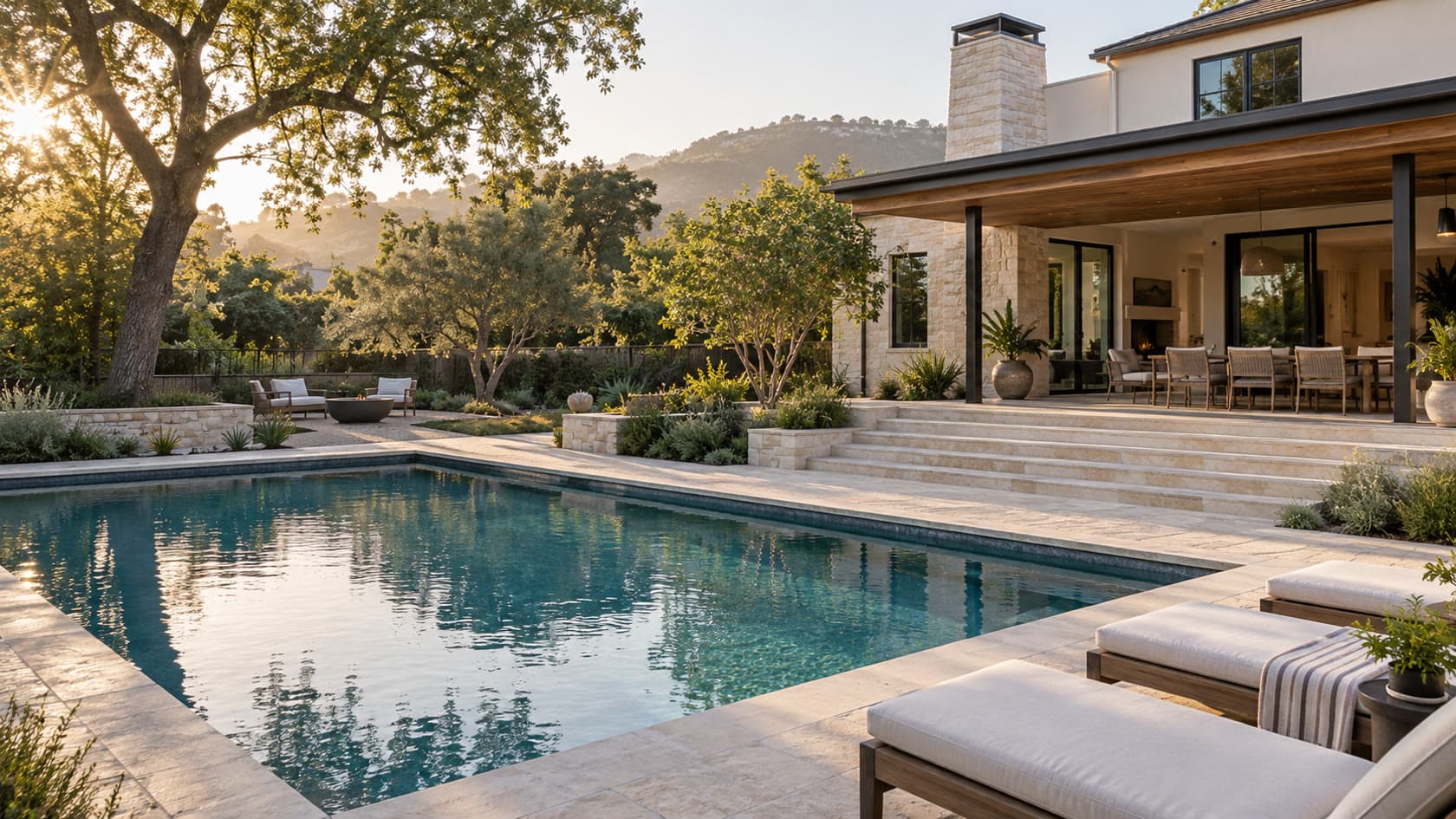
Begin with the complete project boundary
The pool shell is only one part of a finished project. A useful planning budget includes investigation, design, engineering, approvals, access, excavation, structure or shell, finishes, equipment, utilities, drainage, barriers, surrounding surfaces, landscape interfaces, restoration, start-up, and contingency.
Write down what is outside the pool contractor's scope. Owner-managed fencing, electrical upgrades, landscaping, or retaining work still belongs in the project budget even when it is absent from the builder's price.
Property conditions shape the construction plan
Access width, overhead clearance, slope, soil, rock, groundwater, existing utilities, trees, structures, easements, and required protection can change equipment, labor, sequencing, and restoration. Two pools with the same water dimensions can therefore have very different site costs.
Document known conditions early and ask which surveys, utility searches, engineering reviews, or investigations are appropriate before a final scope is agreed. Contingency should reflect unresolved conditions rather than an arbitrary percentage alone.
- Machine and material access route
- Excavation removal and delivery plan
- Grade, drainage, groundwater, soil, and rock
- Utilities, trees, easements, and protected surfaces
Pool system and geometry affect different cost categories
Concrete, fiberglass, and vinyl liner pools use different design, delivery, construction, finish, and future-maintenance paths. Compare systems against the site and intended use before comparing headline prices.
Length, width, depth transitions, benches, steps, integrated spas, raised walls, vanishing edges, water features, and complex curves can affect structure, hydraulics, finish quantities, labor, and surrounding work. Ask which features add both initial complexity and long-term service obligations.
Finishes and surrounding work can rival the shell decision
Interior finish, waterline tile, coping, deck area, deck material, retaining walls, drainage, lighting, planting, shade structures, outdoor kitchens, and furniture define much of the finished setting. Quantities and installation details matter more than broad labels such as standard or premium.
Request square-foot or linear-foot quantities where useful, named products, installation assumptions, and sample approval stages. Coordinate movement joints, drainage falls, thresholds, cover tracks, fence posts, and landscape levels before work reaches those interfaces.
Equipment affects capital and operating decisions
Pump size and control, filtration, sanitation, heating, automation, lighting, cleaners, water features, and cover systems influence both installation and ownership. More equipment is not automatically better; the system should answer the desired use and site conditions.
Ask for model-level specifications, sizing logic, electrical or gas requirements, estimated use patterns, service clearances, warranty conditions, and replacement access. Operating-cost estimates are assumptions, so record energy price, climate, temperature, season, and runtime inputs.
Use ranges and decision gates
Early budgets should be ranges tied to stated assumptions. Tighten the range as site information, design, product selections, approvals, and scope responsibilities become clearer. Do not present an early allowance as a final price.
Create decision gates for system, size, site plan, key finishes, equipment, and surrounding work. At each gate, update the complete project budget and contingency. This keeps design choices connected to their downstream effects.
Pool project cost drivers: common questions
Can a directory provide an accurate project price?+
No. A reliable proposal depends on the property, design, local requirements, chosen systems, and the exact boundary of included work.
What is an allowance?+
It is a planning amount for an item that is not yet fully selected or known. Confirm how any difference will be handled.
Why does access affect cost?+
Access can influence equipment size, labor, material movement, excavation removal, protection, and restoration.
Official and specialist reading
Requirements vary by property and jurisdiction. Verify current rules with the authority responsible for the project.
- U.S. Department of Energy — swimming pool heatingOfficial guidance on heating choices and efficiency considerations.
- ENERGY STAR — pool pumpsEfficiency information for certified pool pumps.
Turn the reading into a project record
Capture the property facts once, then ask every shortlisted company to respond to the same brief and comparison structure.